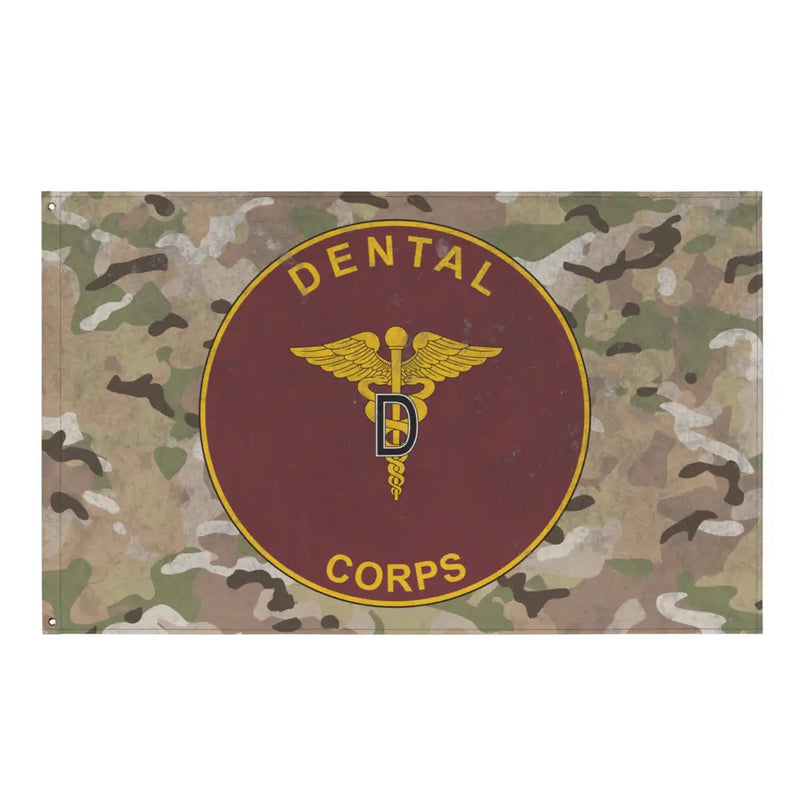
U.S. Army
Dental Corps
A soldier who can't eat can't fight. A dental emergency in a combat zone is a medevac mission that puts more lives at risk. From Civil War recruits who couldn't bite a cartridge to maxillofacial surgeons rebuilding faces shattered by IEDs, the Army Dental Corps has kept the force dentally fit and combat ready for over a century. Dental readiness is a deployment gate. Class 3 means you don't go.
Before the Corps
1775 – 1911
CIVIL WAR
BITE THE CARTRIDGE
Muzzle
Loaded · Paper Cartridge
Bite
Tear Cartridge Open
Front
Teeth Required
Rejected
IF TEETH MISSING
During the Civil War, soldiers loaded muzzle-loading rifles by biting open paper cartridges and pouring the powder down the barrel. A recruit without front teeth couldn't bite the cartridge — and was rejected for service. Dental fitness was literally a requirement to fire a weapon. Some men pulled their own teeth to avoid the draft. Others were turned away because they couldn't pass the bite test. The Army had no dentists. Dental problems were treated by surgeons with extraction forceps and nothing else.
Read more
Explore Collection
EST. 1911
ACT OF CONGRESS
1901
Contract Dentists First
1911
Corps Established
30
Original Dental Officers
Dr. John
SAYRE · FIRST DC
For 136 years the Army had no dentists. Contract dental surgeons were first authorized in 1901, but they held no rank and no military status. On March 3, 1911, Congress finally established the Army Dental Corps as part of the Army Medical Department — thirty dental officers with military rank and authority. Dr. John Sayre is considered the father of the Army Dental Corps, having lobbied Congress for a decade to create it. The Army finally acknowledged that teeth were a military problem.
Read more
Explore Collection
World War II — Global Dental Care
1941 – 1945
WWII
EVERY THEATER
15,292
Dental Officers Peak
65M
Dental Procedures
Mobile
Dental Labs
ETO
PTO · CBI · MTO
The Dental Corps scaled to meet the largest military in American history — over 15,000 dental officers serving across every theater. Mobile dental clinics and laboratories followed the fighting forces from North Africa to the Pacific. Over 65 million dental procedures were performed during the war. Maxillofacial surgeons reconstructed the shattered jaws and faces of combat casualties. The Dental Corps also developed the dental identification system that would become critical for casualty identification — a role that continues today.
Read more
Explore Collection
ORAL SURGERY
COMBAT CASUALTY CARE
Jaw
Facial Reconstruction
Blast
Injuries · Shrapnel
Pioneered
Techniques in War
Walter
REED · BROOKE
The worst wounds in war are often to the face. Army oral and maxillofacial surgeons have been rebuilding shattered jaws, restoring facial structure, and giving wounded soldiers their faces back since WWI. Techniques pioneered in military operating rooms — wiring fractured mandibles, reconstructing blown-away cheekbones, dental implants for blast injuries — moved from the battlefield to civilian medicine. Walter Reed and Brooke Army Medical Center became world leaders in facial reconstruction because war kept providing the worst injuries imaginable.
Read more
Explore Collection
Korea Through the GWOT
1950 – 2021
FIELD DENTAL
KOREA · VIETNAM
MASH
Dental Support
Vietnam
DENTCAP Civic Action
Field
Dental Operating Rooms
Forward
OF THE AID STATION
In Korea and Vietnam, Army dentists operated closer to the fighting than ever before. Dental officers provided emergency oral surgery at MASH units and field hospitals. In Vietnam, the DENTCAP (Dental Civic Action Program) sent military dentists into villages to provide dental care for Vietnamese civilians — hearts and minds through tooth extractions. Field dental operating rooms could be set up in hours, providing definitive care in austere environments that civilian dentists would never see.
Read more
Explore Collection
OIF / OEF
COMBAT DENTAL SUPPORT
Area
Dental Support Teams
FOB
Dental Clinics
IED
Blast Facial Injuries
Readiness
GATE TO DEPLOY
In Iraq and Afghanistan, dental support teams operated on FOBs across both theaters — providing everything from routine cleanings to emergency oral surgery for IED blast injuries to the face. The wars reinforced dental readiness as a deployment requirement — soldiers who weren't dentally fit didn't deploy, period. Maxillofacial surgeons at combat support hospitals treated some of the most devastating facial injuries in military history, caused by IED blasts that body armor couldn't protect against.
Read more
Explore Collection
Active Commands & Training
Today's Dental Corps
DENCOM
JBSA · FORT SAM HOUSTON
DENCOM
Dental Command
JBSA
Fort Sam Houston, TX
29
Dental Activities
600+
DENTAL OFFICERS
The U.S. Army Dental Command (DENCOM) oversees all Army dental care worldwide — 29 dental activities across installations in the continental United States, Europe, Korea, and the Pacific. Over 600 dental officers and thousands of enlisted dental specialists provide comprehensive dental care to soldiers, retirees, and family members. DENCOM ensures the Army meets its dental readiness mission — every soldier dentally deployable at all times.
Read more
Explore Collection
TRAINING
MILITARY DENTISTRY
AEGD
Advanced Education
OMFS
Oral & Maxillofacial
Prosth
Prosthodontics
USUHS
MILITARY MED SCHOOL
The Army trains military dentists through Advanced Education in General Dentistry (AEGD) residencies and specialty programs in oral and maxillofacial surgery, prosthodontics, periodontics, endodontics, orthodontics, and dental public health. The Uniformed Services University (USUHS) postgraduate dental programs train the specialists who handle combat facial trauma. Military dental residencies see cases civilian programs never encounter — blast injuries, ballistic wounds, and mass casualty dental identification.
Read more
Explore Collection
ENLISTED
68E · 68K MOS
68E
Dental Specialist
68K
Medical Laboratory
Chair
Side · Every Day
Field
DENTAL TEAMS
Every Army dental clinic runs on enlisted dental specialists — the 68E dental specialists who work chairside with dental officers, take X-rays, assist in surgery, and manage the patient flow that keeps an installation dentally ready. In the field, enlisted dental techs set up mobile clinics, sterilize instruments in austere conditions, and provide the hands that make forward dental care possible. The dental officers get the degrees. The 68Es do the work.
Read more
Explore Collection
113
Years of Service
600+
Dental Officers
29
Dental Activities
Class 1
Dentally Ready