

Why this dispatch matters
In the wake of the 2003 U.S.-led invasion of Iraq, the Baghdad Zoo—once the largest in the Middle East—was reduced to a devastated shell, with only 35 of its 700 animals left alive amid looting, shelling, and starvation. Amid this chaos, a remarkable coalition formed: U.S. soldiers from the 3rd Infantry Division and 82nd Airborne, Iraqi zookeepers, and global conservationists, including South African Lawrence Anthony, risked their lives to save the remaining animals and restore the zoo. Their courageous efforts not only revived a symbol of peace in a war-torn city but also forged a rare story of hope and humanity during one of the most turbulent chapters of modern conflict.
Author note: Stories from the Tactically Acquired archive, built to connect military history, service identity, and collection discovery.
War, Chaos, and a Forgotten Zoo
In March 2003, as U.S.-led coalition forces advanced into Iraq, Baghdad braced for the storm of war. The city, once a hub of ancient culture and modern ambition, quickly descended into chaos as airstrikes pounded key infrastructure and regime forces crumbled. Amid this backdrop of fire and collapse stood the Baghdad Zoo—once the crown jewel of the city's public spaces and the largest zoo in the Middle East.
Before the invasion, the Baghdad Zoo was home to over 700 animals from across the globe and served as a symbol of civic pride and education. But as Baghdad fell, the zoo suffered the same fate as many of the city's institutions: it was looted, damaged, and largely abandoned. Enclosures were shattered, lions and bears roamed the grounds or were shot, and hundreds of animals were either stolen or died from starvation and neglect. Within days, only a fraction of the zoo's residents remained alive.
Yet, in this grim landscape, a remarkable story of survival and compassion emerged. Iraqi zookeepers who refused to leave their posts, American soldiers who set down their rifles to carry food and water, and international conservationists who flew into a war zone all played roles in one of the most unlikely rescues of the Iraq War. The revival of the Baghdad Zoo became more than a humanitarian mission—it became a symbol of hope amid ruins.
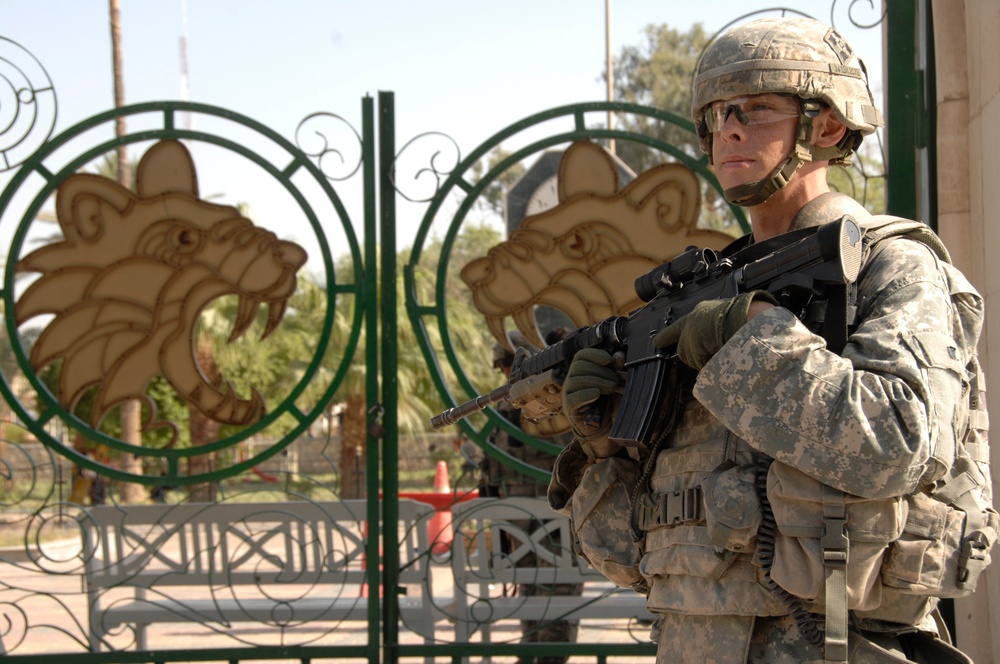 A US Soldier Stands Guard at the Baghdad Zoo
The Fall of Baghdad and the Collapse of the Zoo
Looters, Bombs, and Open Cages
As Baghdad fell to coalition forces in April 2003, the breakdown of law and order was immediate and devastating. Government buildings, museums, and public spaces were looted or destroyed by mobs emboldened by the collapse of Saddam Hussein’s regime. The Baghdad Zoo was no exception. Once protected under the regime’s control, it now stood exposed—unguarded, under-supplied, and directly in the path of Baghdad’s chaos.
A Zoo in Ruins
According to U.S. Army sources and firsthand accounts, looters ripped doors off cages, shot or stole animals, and scavenged equipment for black-market resale. Predators like lions and bears were either gunned down or fled into the city, posing a direct threat to civilians and coalition troops. Monkeys and exotic birds vanished. Tanks and fighting had already damaged parts of the zoo, but it was the looting in the days after the fall that delivered the most destruction.
From Hundreds to Handfuls
The toll was staggering. Of the approximately 700 animals that had once lived in the Baghdad Zoo, only around 35 survived the invasion and its immediate aftermath. Most had died of starvation, dehydration, stress, or violence. Among those that remained were a few lions, some large birds, and a couple of big cats barely clinging to life. Iraqi zookeeper Dr. Adel Mousa, one of the few staff who stayed behind, later recalled hearing gunfire constantly and watching helplessly as animals perished in front of him. The zoo had become a ghost town—a brutal monument to the cost of war on all forms of life.
 An army doctor gives a tiger cub a checkup
First Responders: The Iraqi Zookeepers Who Stayed
As chaos consumed Baghdad in April 2003, when most fled or hid in fear, a few Iraqi zookeepers chose a different path: they stayed. Among them was veterinarian Farah Murrani, along with senior staff like Dr. Adel Mousa, and other unnamed workers who refused to abandon the animals they had cared for—some for decades. Their choice was not without risk. With sniper fire echoing across the city, no government support, and roving looters armed and aggressive, every trip into the zoo grounds was potentially fatal.
Risking Everything to Feed the Animals
These keepers scoured the ruined city for any source of food or water. Farah Murrani recalled in interviews how she and her colleagues siphoned water from garden hoses, scavenged market stalls for scraps, and at times used their own limited food rations to feed the starving animals. Despite cages destroyed by bombs and animals either panicked or aggressive from starvation, they continued returning, coaxing survivors to eat, patching wounds, and doing what little veterinary care they could manage.
Improvised Tools in a Warzone
With no electricity, no medicine, and no proper animal feed, the staff adapted creatively. They fed lions boiled chicken, used ropes and nets to create makeshift barriers, and rationed water by hand. One lioness, severely dehydrated and near death, was revived by the team with fluids administered using IV tubing and a water bottle. The staff’s deep emotional connection to the animals and their sense of duty kept them going. As Farah put it, “These animals had no one else.”
Their perseverance became the backbone of the Baghdad Zoo’s survival and would soon intersect with an unlikely wave of support from U.S. soldiers and international wildlife experts. But in those early days, it was the Iraqi staff—largely unnamed and unrecognized—who formed the first, fragile line of defense against complete extinction.
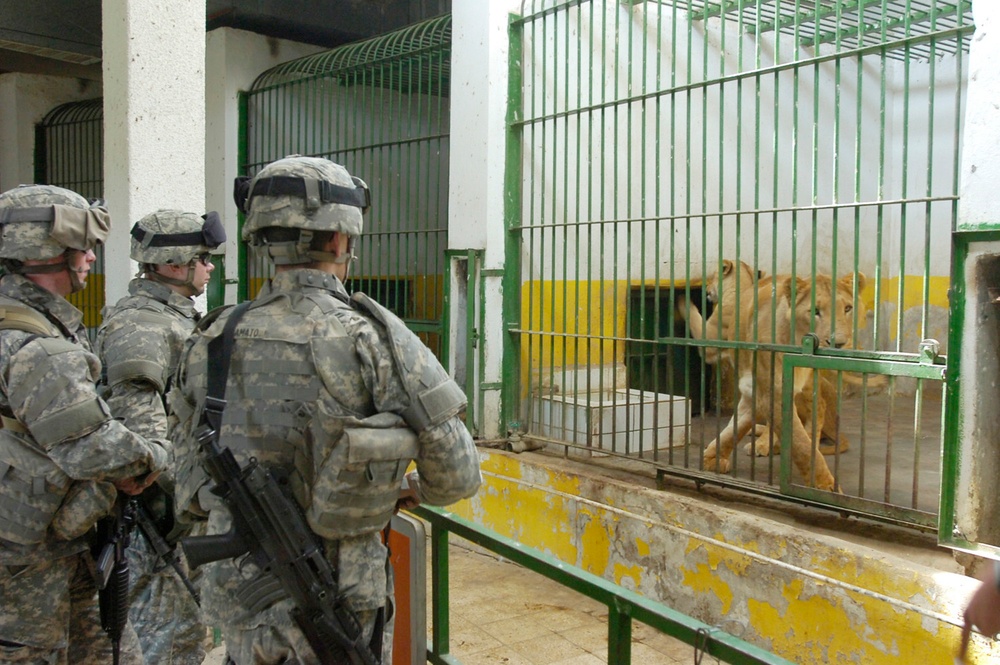 15th Brigade Support Battalion begin work with Baghdad Zoo
When Soldiers Become Caretakers
When Soldiers Found a Zoo
In the wake of Baghdad’s fall in April 2003, U.S. forces entered a city ravaged by looting and disorder. Amid the wreckage, soldiers from the 3rd Infantry Division and the 2nd Brigade Combat Team of the 82nd Airborne Division stumbled upon the Baghdad Zoo — its gates unsecured, its animals starving, and its infrastructure in ruin.
Rather than moving on, these soldiers took the extraordinary step of staying. Recognizing both the humanitarian crisis and symbolic importance of the zoo, they shifted from combat operations to caretaking — guarding animals, restoring enclosures, and bringing order to a place that had become a microcosm of the wider chaos engulfing Iraq.
Feeding Lions with MREs
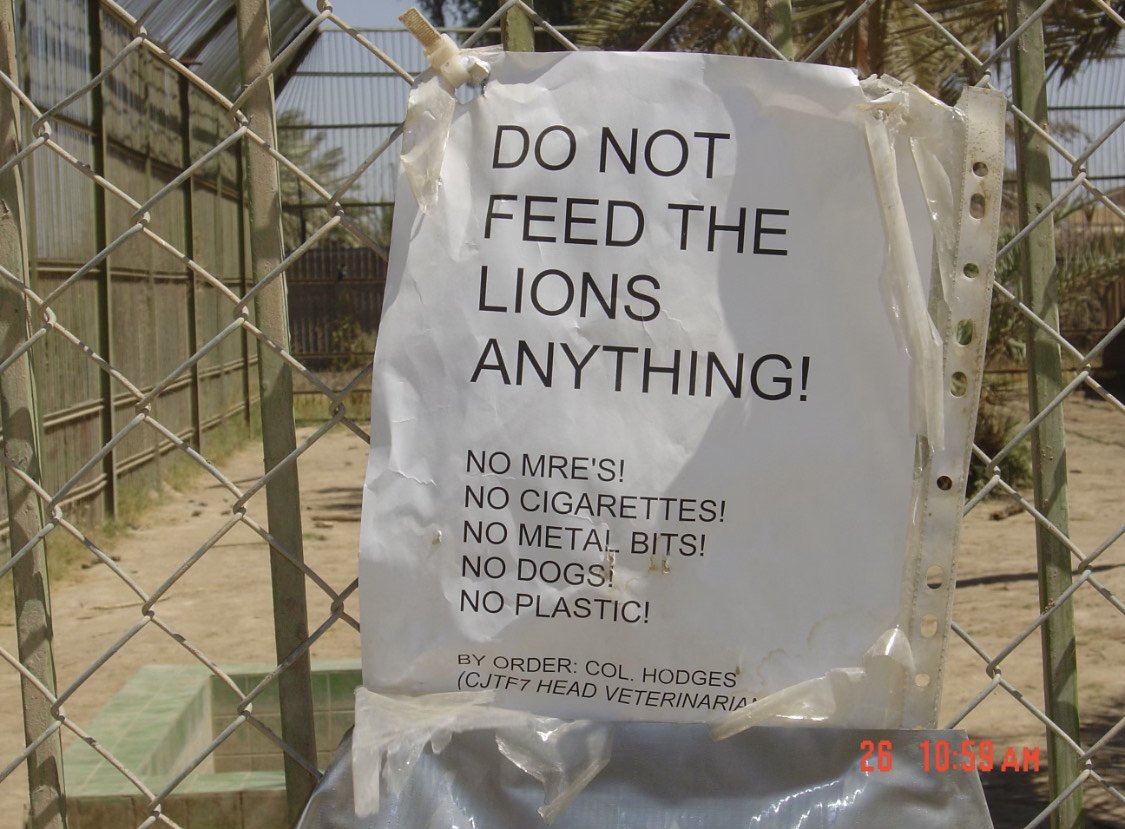
One of the most iconic images to emerge from this period is that of U.S. soldiers feeding malnourished lions using MREs. With traditional food sources inaccessible or nonexistent, troops used whatever rations they had on hand to keep the animals alive. According to reports from CBS News and Army.mil, this included hamburger patties, rice, and other meal components repurposed for desperate zoo residents. This ad hoc caretaking helped stabilize some of the remaining animals, especially the predators, while civilian staff and volunteers worked to source proper food and medical supplies.
Leader on the Ground
In the aftermath of the 2003 invasion of Iraq, Captain William Sumner, a civil affairs officer with the U.S. Army's 354th Civil Affairs Brigade, was assigned to assess the condition of the Baghdad Zoo. Upon arrival, he found the zoo in a state of devastation: of the approximately 650 animals that once resided there, only about 30 remained, primarily large predators like lions and tigers that had managed to fend off looters. The surviving animals were in dire conditions—starving, dehydrated, and confined in damaged enclosures.
Recognizing the urgency, Captain Sumner took the initiative to coordinate rescue and rehabilitation efforts. He organized a team comprising zoologists, veterinarians, conservationists, and fellow soldiers to provide immediate care for the animals and to begin restoring the zoo's infrastructure. This collaborative effort extended beyond the zoo's original grounds; Sumner's team also rescued animals from other locations, including private collections and facilities once owned by Saddam Hussein and his family. These rescues brought in a variety of animals, such as cheetahs, lions, and Arabian horses, all of which were relocated
Global Attention and Support
Anthony’s high-profile intervention brought much-needed international attention to the plight of the Baghdad Zoo. Wildlife NGOs, including the Association of Zoos and Aquariums (AZA) and animal welfare groups, began sending supplies and expertise.
Veterinarians from across the globe volunteered to assist, and through these combined efforts, the zoo not only avoided collapse—it began to slowly recover. As Esquire Middle East noted, this unlikely coalition of soldiers, scientists, and civilians formed one of the most poignant alliances of the early Iraq War, aimed not at destruction, but renewal.

Al Zawra’a Gardens area along with the Al Zawra’a Dream Park, part of the current zoo
Rebuilding Amid Ruins
Brick by Brick, Cage by Cage
The fall of Baghdad in April 2003 left behind a shattered city—and a zoo on the verge of extinction. Once looted, bombed, and forgotten, the Baghdad Zoo was reduced to broken concrete, twisted fencing, and a haunting silence where once roars and chirps had echoed. With just a few dozen animals clinging to life, the zoo stood as a symbol of the city's unraveling—and an unlikely candidate for revival. But against all odds, an international coalition of soldiers, zookeepers, veterinarians, and volunteers began the painstaking task of rebuilding it.
What unfolded was not simply an act of animal rescue—it was a deeply human act of resistance against the tide of destruction. Every cage rebuilt, every animal fed, and every gate rewelded was a gesture of hope, resilience, and the enduring power of compassion.
Structural Repairs Begin
When U.S. troops first arrived, the Baghdad Zoo was barely recognizable. Enclosures were burned or looted, the animal hospital was gutted, and critical infrastructure—electricity, plumbing, and security systems—was gone. The surviving animals, including lions and bears, were housed in dangerously compromised cages.
U.S. Army engineers, particularly those from the 15th Brigade Support Battalion and other support elements working with the 2nd Brigade Combat Team, 82nd Airborne Division, joined forces with Iraqi staff to begin emergency stabilization. Temporary fencing was put in place using scrap metal. Water tanks were trucked in daily, and tools were shared between military units and zoo workers. Even combat engineers and mechanics—more used to repairing vehicles than animal pens—rolled up their sleeves to restore what they could.
One soldier described the effort as “rebuilding from the bones.” With no blueprints and limited resources, repairs were improvisational. Still, day by day, enclosure by enclosure, the zoo began to take shape again.
The Return of Animals
As reconstruction efforts took hold and the Baghdad Zoo regained a semblance of stability, the careful and symbolic reintroduction of animals began. Native species such as monkeys, foxes, and various birds were the first to return, chosen for their adaptability and the relative ease of transportation. But the revival extended beyond restocking from abroad—many animals were recovered from abandoned private collections and war-torn sites across Iraq, including exotic pets once owned by Saddam Hussein and his inner circle. These animals, neglected or endangered in the chaos, were brought to the zoo for safekeeping and care, turning the facility into an unexpected sanctuary.
One of the most celebrated moments came with the arrival of two Bengal tigers donated by the United Arab Emirates. Airlifted into Baghdad as an international gesture of goodwill, the tigers were placed in a newly constructed, secure enclosure designed to meet international standards. The event was widely covered by global media, including CBS News and the BBC, and marked a significant turning point in the zoo’s rehabilitation. For many Iraqis, the return of large, majestic animals symbolized not only the revival of a beloved public institution but also a glimmer of hope amid widespread destruction.
As these animals settled into their new homes, Iraqi families began to return as well. The presence of lions, bears, and tigers once again behind secure fencing offered not just entertainment, but reassurance—a visible sign that life, care, and even beauty could survive the brutality of war.

US army sergeants transport one of Uday Hussein's lions from his palaces inside the Green Zone to the Baghdad zoo (Joe Raedle/Getty Images)
Preventing Another Collapse
While the physical zoo was being reconstructed, there remained one critical task: ensuring it wouldn't fall apart again. Security, staffing, and funding had to be stabilized or the project would unravel.
Looting had devastated the zoo in the early days of the invasion, so the U.S. military increased patrols around the perimeter, and installed secure locks and reinforced gates.
Meanwhile, humanitarian NGOs and international conservationists began supplying resources, ranging from food and medical equipment to payroll stipends for zoo staff. Many of the zookeepers—unpaid for weeks—remained on the job out of sheer dedication. Their commitment, now backed by external aid, ensured that daily operations could continue.
More Than Just a Restoration
To rebuild the Baghdad Zoo was to assert the value of life in the shadow of destruction. The work done here was not flashy, nor was it often headline-making. But its impact—on the city, the animals, and the people—was profound.
Each repaired brick and filled water trough represented a small defiance of the chaos that surrounded Baghdad. Soldiers, conservationists, and zookeepers formed an unlikely alliance, one that transcended culture, language, and even duty, to protect something gentle amid a world at war.
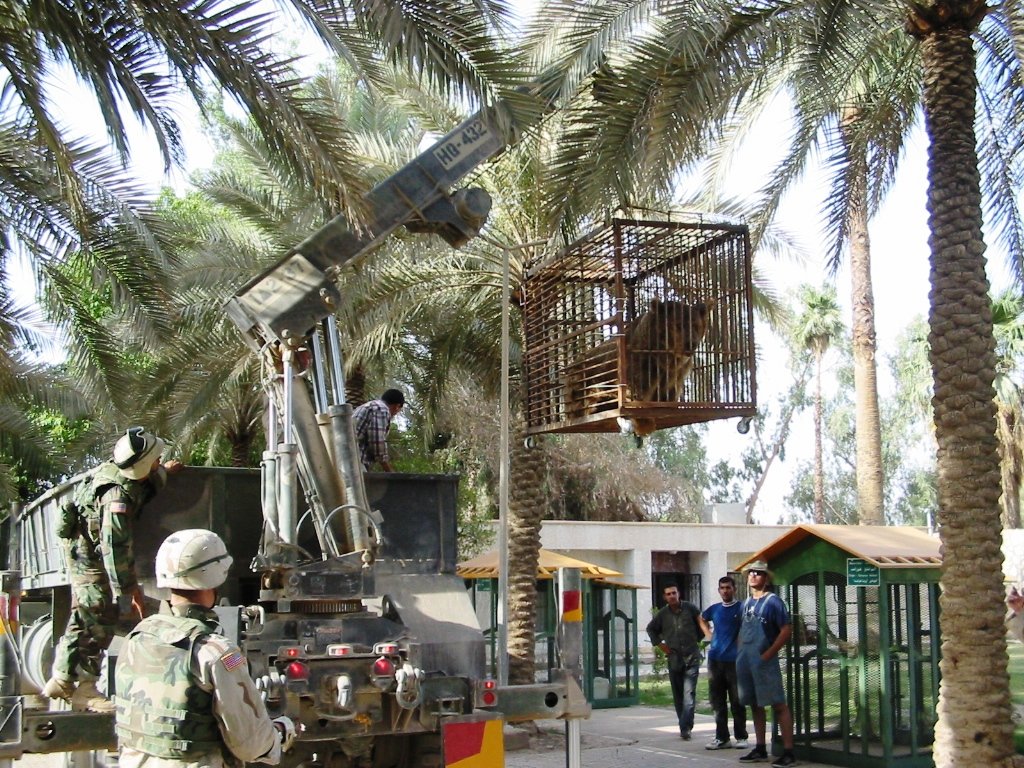
The rescue of Samir, the brown bear, at the Lunar Park Zoo. The US Army used a Heavy Expanded Mobility Tactical Truck’s hydraulic arm to lift the cage into the back of the transport truck and to bring him to the Baghdad Zoo
The Zoo Today
A Symbol of Hope
More than two decades after the bombs fell and the cages were torn open, the Baghdad Zoo still stands—not only as a haven for animals, but as a rare space where Iraqis can glimpse a sense of normalcy, continuity, and peace. Though it once held the title of the largest zoo in the Middle East, today's Baghdad Zoo wears a quieter mantle: that of a survivor.
Keep the reader moving

If the invasion had been postponed to the next available window on June 18-20, the consequences would have...

The scale of the challenge was almost incomprehensible. In 1940, the entire American military establishment was built around...
Five programs. Conceived in the early 1970s. Fielded by the early 1980s. Proven in combat in 1991. Still...
Continue the mission
Get new dispatches, conflict drops, and collection launches delivered directly to your inbox.