
ENABLE AUDIO
This experience includes combat sounds, artillery, B-52 sorties, and radio chatter. Click anywhere to enable audio.
DAY 0 OF 77
21 JAN 1968
AMBIENT
77
DAYS
Khe Sanh Combat Base - Quang Tri Province, RVN
21 JANUARY - 08 APRIL 1968
SCROLL TO BEGIN
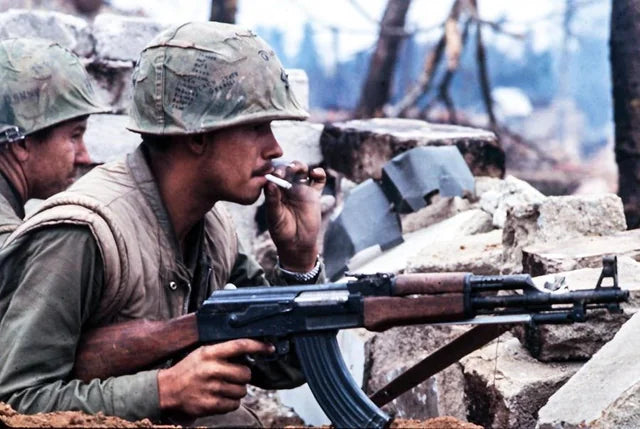
Khe Sanh sat in a valley of red laterite dirt, ringed by hills draped in triple-canopy jungle, six miles from the Laotian border and fourteen miles south of the DMZ. The 26th Marine Regiment held the plateau - a combat base carved from earth the color of dried blood, anchoring the western end of the McNamara Line.
By January 1968, intelligence reports painted an increasingly grim picture. Two full NVA divisions - the 304th and 325C - were converging on the base. Radio intercepts, sensor readings, and patrol contacts all pointed to the same conclusion: the North Vietnamese were preparing something massive.
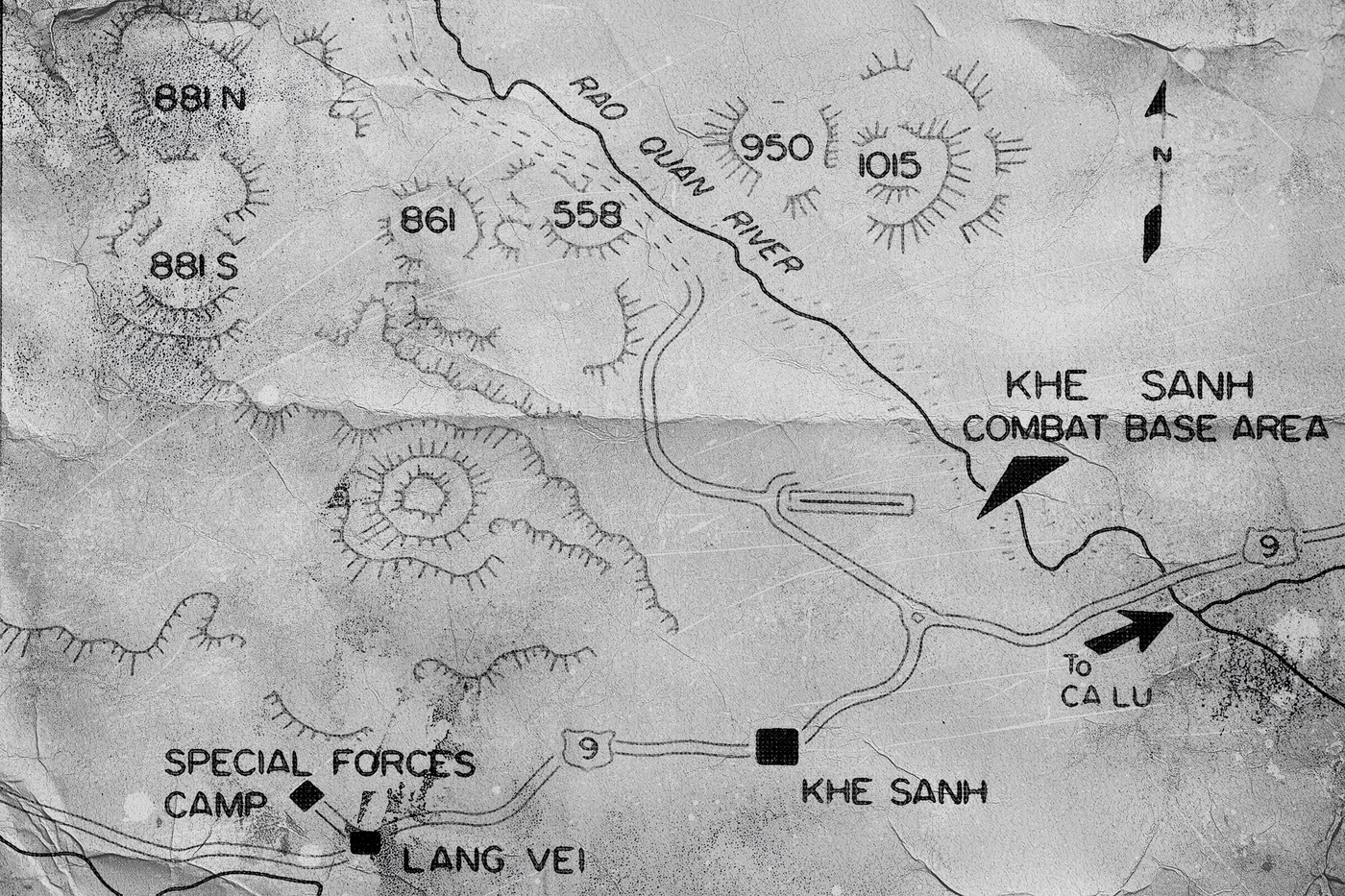
Khe Sanh Combat Base - Surrounding Hills & Route 9
General Westmoreland saw Khe Sanh as the place to break Hanoi's conventional forces with American firepower. Hanoi saw it as another Dien Bien Phu - a chance to destroy an isolated garrison and shatter American will. Both sides were about to get the fight they wanted.
6,000MARINES HOLDING THE BASE
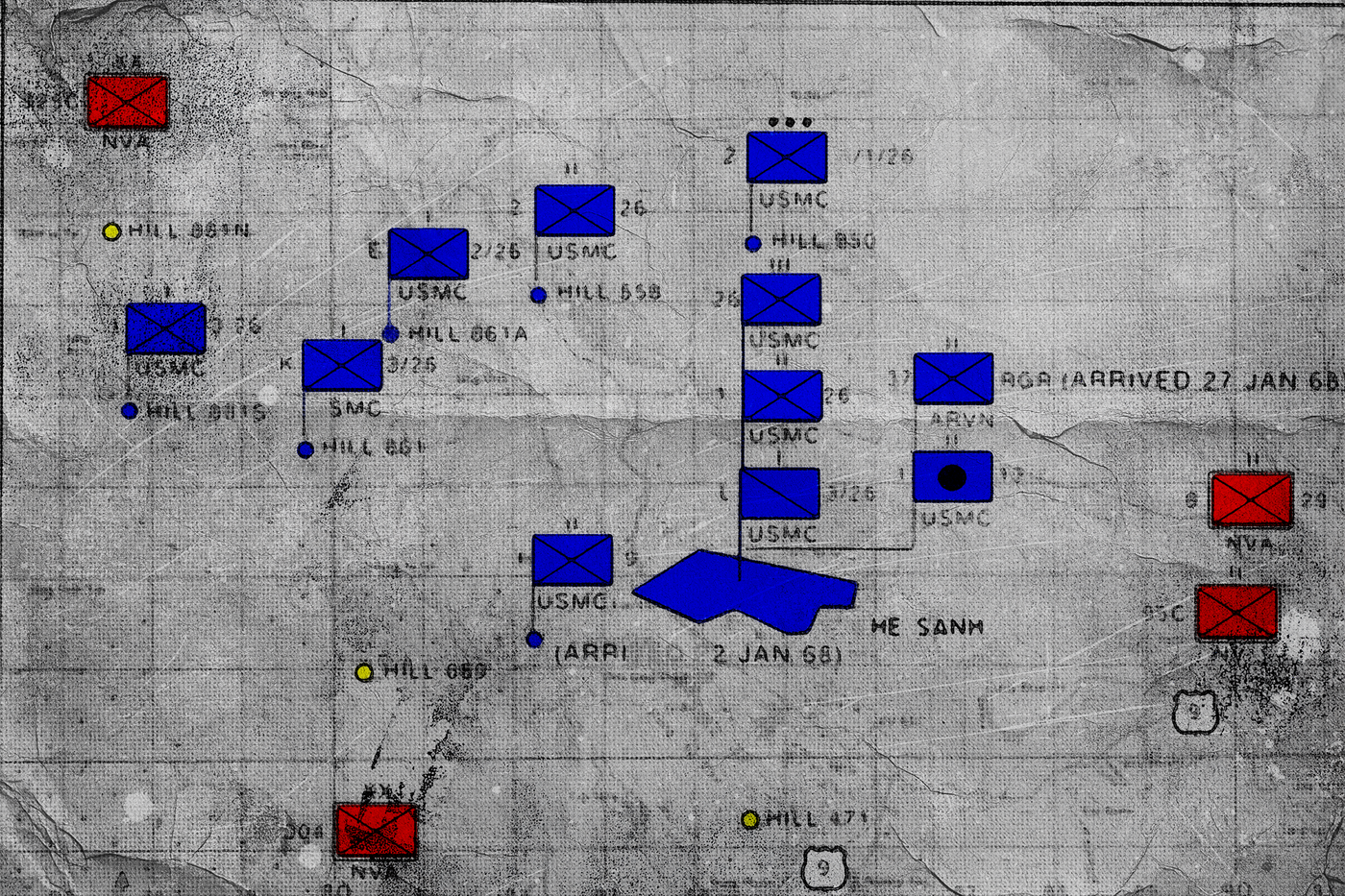
Unit Positions - Blue: USMC / Red: NVA
Against them stood an estimated 20,000 to 30,000 NVA regulars dug into the surrounding hills and jungle, equipped with artillery, rockets, mortars, and anti-aircraft weapons staged along the Ho Chi Minh Trail just across the border.
20,000+NVA SURROUNDING THE PERIMETER
The Siege Begins
D1
21 JANUARY 1968
The Siege Begins
At 0530, NVA forces launched a coordinated assault on Hill 861, hitting the Marine outpost with a ground attack preceded by intense mortar fire. The assault was repulsed, but it was only the opening act.
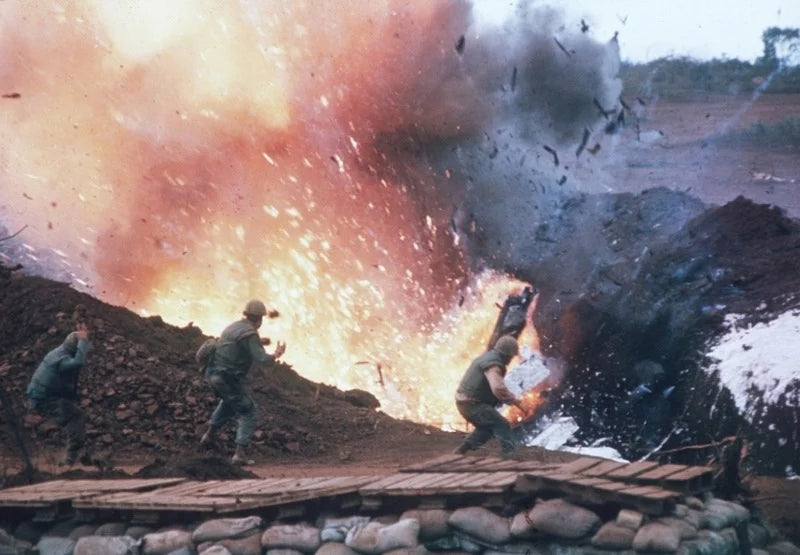
Hours later, a barrage of NVA rockets and artillery slammed into the main combat base itself. A direct hit on the primary ammunition supply point ignited 1,500 tons of munitions. The explosion was apocalyptic - a column of fire and smoke that could be seen for miles, sending shrapnel screaming across the base and destroying nearly the entire store of CS tear gas.
RED SECTOR ACTUAL: Ammunition supply point is gone. Say again - the ASP is gone. Taking heavy incoming across the entire base. Request immediate resupply. Over.
As darkness fell on January 21st, the Marines of the 26th Regiment understood with absolute clarity what was happening. They were surrounded, outgunned, and the only way in or out was by air - air that would have to fly through some of the heaviest anti-aircraft concentrations in South Vietnam.
The siege of Khe Sanh had begun.
Digging In
D5
25 JANUARY 1968
Digging In
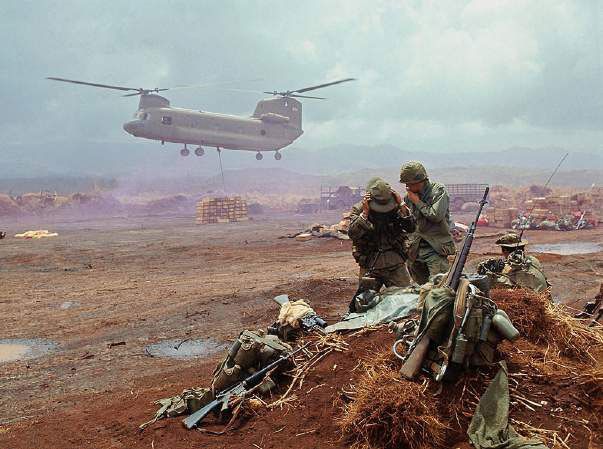
The first week established the brutal rhythm that would define the next two months. The NVA settled into a pattern of sustained bombardment - rockets, artillery, and mortars raining onto the base at unpredictable intervals. On some days, more than 1,000 rounds impacted the perimeter. Marines lived underground, deepening trenches and bunkers with every spare moment.
The fog was the enemy within the enemy. A thick monsoon blanket settled over the valley most mornings, reducing visibility to near zero and grounding the helicopters and cargo aircraft that were the base's only lifeline. When the fog cleared, the NVA gunners had been waiting.
FOXTROT 6: Fog bank is solid. No visibility past the wire. Request air resupply is negative until further. Rations down to one meal per day. Water situation critical. Over.
Incoming

0
INCOMING ROUNDS PER DAY
Life Underground
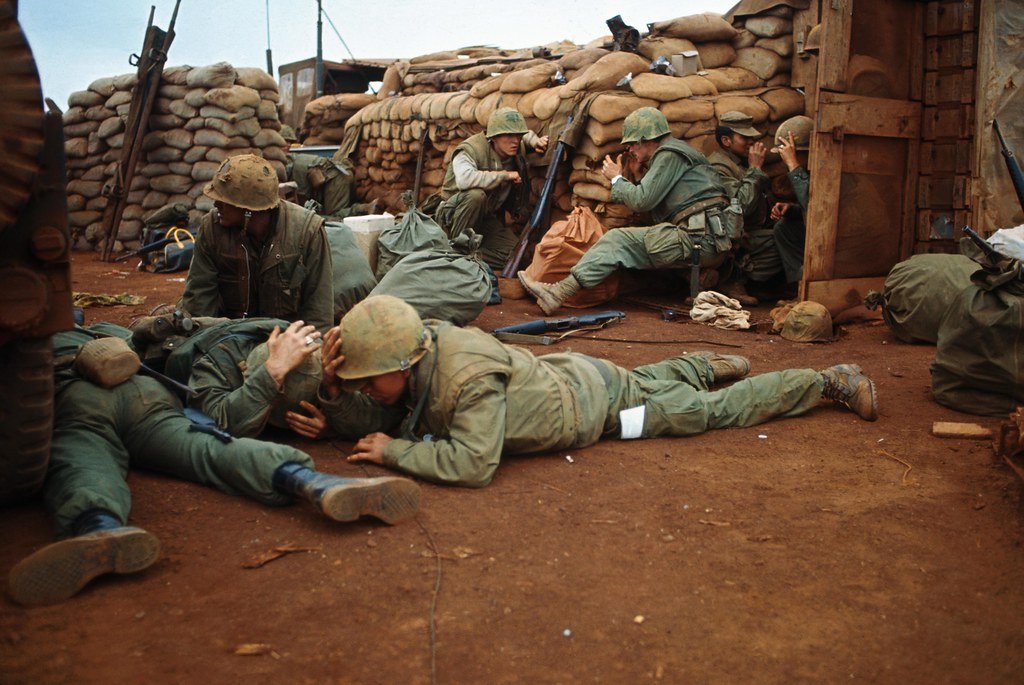
"You learned to count the seconds between the sound and the impact. You learned to tell the difference between a rocket and a mortar by the whistle. You learned to sleep with your flak jacket on and your helmet within arm's reach. You learned all of this, or you didn't make it." - MARINE, 1ST BATTALION, 26TH MARINES
D17
6–7 FEBRUARY 1968
Lang Vei Falls
Nine miles southwest of Khe Sanh, the Special Forces camp at Lang Vei came under assault by NVA infantry supported by PT-76 Soviet-made tanks - the first time North Vietnam had employed armor in the south. The camp was overrun in a matter of hours.
Survivors and indigenous forces fled toward Khe Sanh, but the decision to allow them into the Marine perimeter was agonizing. Intelligence feared NVA infiltrators among the refugees. The fall of Lang Vei sent a clear message: the NVA were willing to commit everything. Khe Sanh was truly alone.
LANG VEI ACTUAL: We are being overrun. Tanks inside the wire. PT-76s. I say again - enemy armor inside the perimeter. Request immediate extraction. Over.
The Hill Fights
881S
▸ HILL 881 SOUTH
The Watchtower
India Company, 3/26 Marines held Hill 881 South - the highest point in the defensive network. From its summit, forward observers could direct devastating fire onto NVA positions. The hill was under near-constant bombardment, and every resupply helicopter was a target. Marines here fought in some of the most extreme isolation of the entire siege, separated from the main base by valleys crawling with NVA.
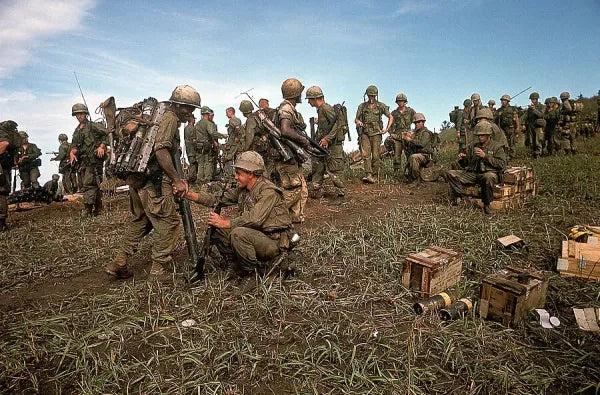
26th Marines - Mortar Position, Khe Sanh
861
▸ HILL 861
First Blood
The opening attack of the entire siege fell on Hill 861's defenders. Kilo Company, 3/26 repelled the initial NVA ground assault in brutal close-quarters fighting. The hill remained a critical northern anchor throughout the siege, its defenders enduring daily bombardment while maintaining observation of NVA approach routes through the valley below.
861A
▸ HILL 861-ALPHA
The February Assault
On February 5th, the NVA launched a massive ground assault on 861A under cover of fog and darkness. Echo Company, 2/26 fought hand-to-hand in their own trench lines. The fighting was so close that Marines called artillery on their own positions. The hill held, but barely - the NVA penetrated the perimeter before being driven back in some of the fiercest combat of the entire siege.
950
▸ HILL 950
The Radio Relay
Hill 950 served as the critical radio relay station connecting Khe Sanh to higher headquarters. Its small garrison - a reinforced platoon - maintained communications through some of the worst weather and heaviest bombardment of the siege. Loss of Hill 950 would have severed Khe Sanh's ability to coordinate the massive air support that kept the base alive.
Operation Niagara
D35
FEBRUARY 1968
Operation Niagara
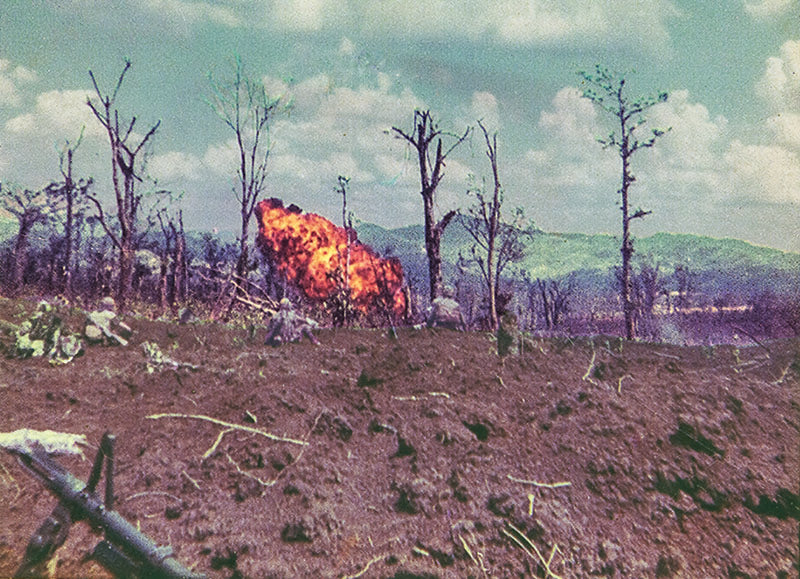
What Khe Sanh lacked in maneuver room, it made up for in firepower from the sky. Operation Niagara was the most concentrated application of aerial firepower in the history of warfare to that point. B-52 Stratofortresses flew Arc Light missions around the clock, each aircraft dropping over 100 bombs per sortie. The ground shook constantly - Marines could feel the B-52 strikes through the earth in their bunkers.
Tactical air from Marine, Navy, and Air Force squadrons supplemented the B-52s with napalm, high-explosive bombs, and cluster munitions. On average, a tactical airstrike hit NVA positions every five minutes during the siege.
24,000
TACTICAL AIR
SORTIES FLOWN
SORTIES FLOWN
2,700
B-52 ARC LIGHT
SORTIES
SORTIES
110,000
TONS OF ORDNANCE
DROPPED
DROPPED
12,000
SUPPLY TONS
DELIVERED BY AIR
DELIVERED BY AIR
ARC LIGHT CONTROL: Cells inbound your position. Impact in figures three minutes. Mark friendlies. Danger close advisory - minimum safe distance 1,000 meters. Confirm all personnel in covered positions. Over.
The Darkest Days

"The red dirt got into everything - your food, your weapon, your lungs, your soul. After a while you couldn't remember what it was like to be clean. You couldn't remember what it was like to stand up without flinching. The world had shrunk to the size of your fighting hole, and every sound was a calculation - is this the one that gets me?" - CORPORAL, 2ND BATTALION, 26TH MARINES
D55
MARCH 1968
Endurance
By March, the siege had ground into a war of endurance. The daily rhythm was relentless: bombardment, resupply attempts, patrols, bombardment, darkness, bombardment. Marines who had arrived clean-shaven and squared away were now gaunt, red-dusted figures who moved in hunched, automatic patterns - always below the trench line, always listening.
Water was rationed. C-rations were monotonous. Mail was sporadic. But the line held. Every morning, the Marines of the 26th Regiment woke up, checked their weapons, counted their rounds, and held their ground against an enemy that outnumbered them more than three to one.
The NVA pressed constantly - probing attacks, sniper fire, attempts to breach the wire at night. Sensor strings and listening posts provided early warning, but the tension of waiting for the mass assault that intelligence kept predicting was its own form of warfare.
Relief
D66
1 APRIL 1968
Operation Pegasus
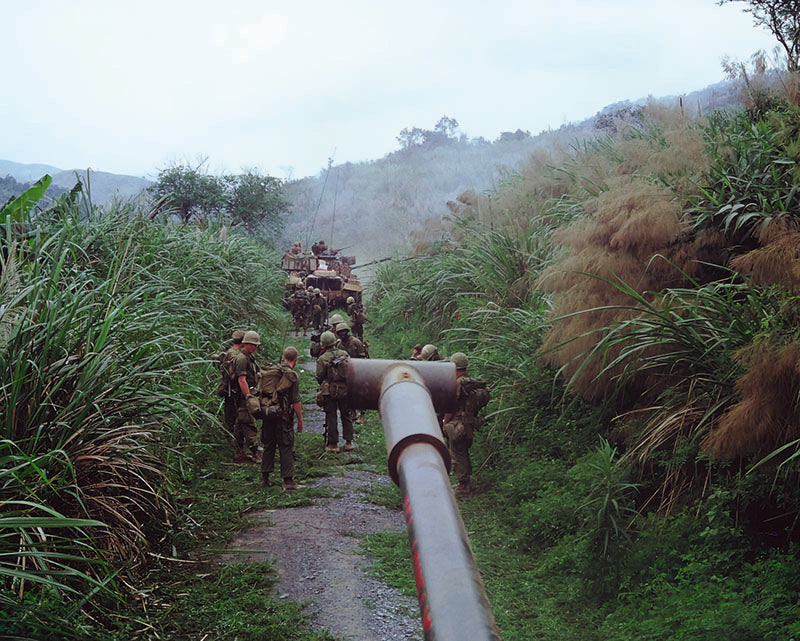
The 1st Cavalry Division (Airmobile) launched Operation Pegasus - a combined ground and air assault to reopen Route 9 and relieve Khe Sanh. Thirty thousand troops, supported by massive air cover, pushed west along the road and through the surrounding jungle. The 1st Marines attacked south from positions near the Rockpile.
The NVA, battered by months of sustained bombardment and with their supply lines shattered, began withdrawing. The forces that had surrounded Khe Sanh melted back into the jungle and across the Laotian border. After 66 days of total isolation, the garrison could hear friendly armor approaching on Route 9.
PEGASUS ACTUAL: Lead elements 1st Cavalry approaching Red Sector. Route 9 open to vehicular traffic. Linkup with 26th Marines imminent. Over.
Day 77
April 8, 1968
The Siege Is Lifted
After 77 days of continuous siege, Khe Sanh was officially relieved. The 26th Marine Regiment - battered, thinned, red-dusted to the bone - had held. Not one inch of the perimeter had been permanently lost. Not one hill outpost had fallen.
The cost was measured in blood on both sides. Estimated NVA casualties ranged from 10,000 to 15,000 killed, their divisions shattered by the most concentrated aerial bombardment campaign in the history of warfare. The Marines and their supporting forces paid their own price - in lives, in wounds, in the invisible scars carried home by every man who survived those 77 days in the red dirt.
In an irony that would define the war itself, Khe Sanh Combat Base was abandoned and demolished just weeks after the siege ended. The strategic calculus had shifted. The ground that so many had fought and died to hold was given back to the jungle.
But the men who held it never gave it up. Not while they were there. Not in 77 days.
274
AMERICANS KILLED IN ACTION AT KHE SANH
To every Marine, Soldier, Sailor, and Airman who held the line at Khe Sanh Combat Base - and to those who never came home from the red dirt - your 77 days are not forgotten.
SEMPER FIDELIS